Learn from the past to combat ableism on campus
This is a letter to the editor.
To the editor,
Ableism is the discrimination against disabled people or the favoring of able-bodied people in public and private realms. Ableism is steps at the front door of a business with a ramp only being available via the backdoor. Ableism is students being denied accommodations necessary for academic success.
Like all long-standing institutions, CSB+SJU has been battling ableism for decades. Whether it’s the first support group for disabled students, a faculty member standing up against construction plans or the implementation of Student Accessibility Services in 2011, the fight against ableism on our campuses is worth examining. Actively combatting discrimination against disabled people is one way we can foster a deeper sense of community and ensure CSB+SJU is working towards accessibility for all.
CSB+SJU has come a long way regarding ableism. In the dismissal of students section in the CSB Bulletin of 1962-64, it states that the school has the right to dismiss students based on physical disabilities that endanger the welfare of the student community. This is echoed in the 1966-68 update in terms of psychological disabilities. We can see positive change in the 1980-82 catalog when it specifies that the College of St. Benedict does not discriminate against the handicapped in admission or access to their programs and activities. The schools also included disability awareness week in the 1984 academic calendar.
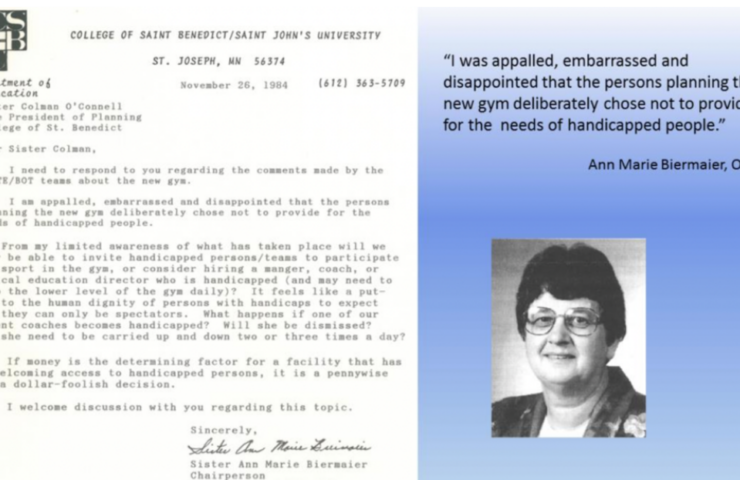
Sister Ann Marie Biermaier raised concerns in 1984 about the lack of accessibility in the Claire Lynch gymnasium building plans. She wrote a letter voicing to the vice president of planning and stated, “I was appalled, embarrassed and disappointed that the persons planning the new gym deliberately chose not to provide for the needs of handicapped people.” Her mother, who used a walker, introduced her to disability awareness. Biermaier claims that if you do not have someone close to you who needs accommodation, then you are likely not as aware of what isn’t accessible. Biermaier says it was her “duty” to advocate for inclusive spaces on campus.
It’s important to recognize that progress made in the 1980s was due to social change, as there was not federal protection for disabled people. After the Americans with Disabilities Act of 1990 was passed, great strides were made on campus. According to St. Ben’s Archives, in 1994, a support group was formed on campus for disabled people or people who wanted to listen and support disability activism. Acknowledging the presence of disabled people on campus and holding space for them marks a progression in the fight against ableism on campus. Following the ADA’s creation, Academic Advising provided support for students with disabilities until Student Accessibility Services was established in 2011.
Student Accessibility Services, also known as SAS, provides students with the accommodations they need to succeed at CSB+SJU. Students are given options such as more time on tests or taking exams in a distraction-reduced area. SAS also helps students receive lecture notes or presentations prior to class time and allows them to use whatever tools hey need to succeed, such as recording class lectures and allowing phone access to take pictures of chalkboards or whiteboards. An underutilized tool is Speechify, a program that converts text to speech using voices like Snoop Dogg, Mr. Beast, or Gwyneth Paltrow from any website within your browser. SAS is a great resource for students to utilize at CSB+SJU to achieve the education that everyone deserves.
The CSB+SJU campuses have implemented aspects of universal design: the design of buildings, products or environments to make them accessible to people regardless of age, disability or other factors. It differs from accommodations by including everyone in its concept instead of being a reactive process. Examples on campus include ramps, curb cuts, handles instead of doorknobs and benches in public spaces to offer rest opportunities. Some remaining barriers include pavers that create a tripping hazard and increase friction for rolling mobility aids, steps into entrances and harsh lighting.
Bennies make up more than half of the students who use SAS. With Johnnies using SAS at a lower rate, this alludes to a stigma that is still prominent on campus regarding masculinity. However, exemplifying healthy masculinity can be achieved by knowing when to ask for help, which leads us to challenge Johnnies to balance the usage rates. Individuals can stop by the SAS Office in the HAB at St. Ben’s to discuss potential resources that will be beneficial to them in a confidential environment. Combatting ableism means viewing accommodations as a right and not a burden. It is important to realize that accepting help does not make someone less than. Minimizing internalized ableism will contribute to a decrease in ableism on campus, making the CSB+SJU community more welcoming and inclusive.