Native American Heritage Month brings speaker to CSB
Giiwedin, an Anishinaabe Two-Spirit Influencer, was invited to CSB+SJU as a speaker for Native American Heritage Month for a discussion on identity within the indigenous community, environmental consciousness, activism and advocacy on social media.
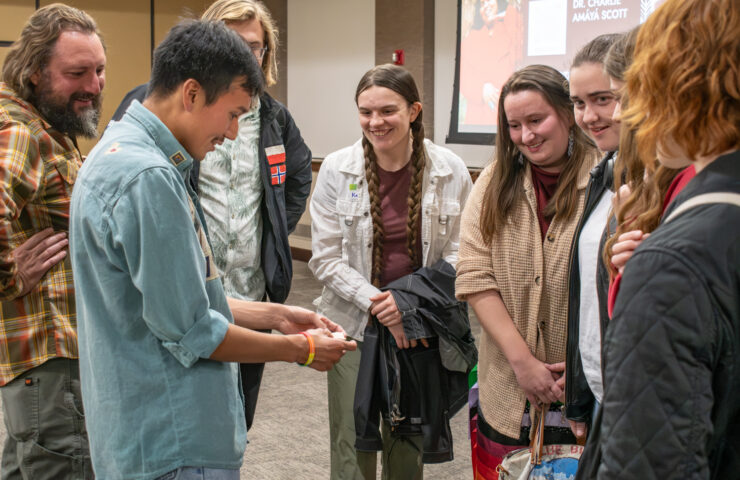
CSB+SJU invited Anishinaabe Two-Spirit influencer Giiwedin on Tuesday, Nov. 10, to discuss the intersections of Indigenous identity, social media and environmental activism.
Giiwedin visited campus for a presentation titled “What it Means to Be a Two-Spirit Influencer: A Story of Social Media and Environmental Activism.” The lecture was organized by CSB+SJU’s Initiative for Native Nation Relations (INNR), Indigenous Student Association (ISA), Queer Proud Lavender Union for Students (QPLUS) and the Environmental Studies department in recognition of Native American Heritage Month. Following a social reception at 6 p.m., the event was held from 6:30-8 p.m. at the Gorecki Center at St. Ben’s.
An enrolled member of the St. Croix Chippewa Indians of Wisconsin, Giiwedin (@ giiwedinindizhinikaaz on Instagram) uses social media to share information about Indigenous issues, environmental advocacy, Queer Indigenous history and Anishinaabe culture. One thing that they highlight is birch bark biting, an artform made by various Algonquian tribes where artists bite on pieces of birch bark to create designs and patterns.
At the event, Giiwedin introduced themself and shared that their name means “North Wind” in Ojibwe. They also identified themself as Bear Clan and shared their connection to the Leech Lake Reservation in northern Minnesota, where they grew up with their grandparents.
Throughout the presentation, Giiwedin discussed the meaning and history of Two-Spirit identity, emphasizing that Indigenous communities are not culturally interchangeable.
“Native American peoples are not a monolith,” Giiwedin said. “There are thousands of tribal nations, thousands of tribal communities, all with their own cultures, their own languages and their own understandings of the world.
Giiwedin explained that Two- Spirit is an umbrella term used by some Indigenous people to describe tribally specific gender or social roles. The term was introduced at an intertribal Native American First Nations gay and lesbian conference in Winnipeg, Manitoba, in 1990. Its creation was an effort to reclaim Indigenous identity and move away from terminology imposed by European colonizers.
Giiwedin also discussed how colonization and forced assimilation affected Indigenous understandings of gender, including through the suppression of spiritual traditions and the imposition of strict gender binaries.
Brandon Patton, an SJU senior who attended the lecture, said he appreciated the opportunity to learn about a topic he was not previously familiar with.
“I think this is a really cool event because, like, I know nothing about Two-Spirit,” Patton said. “Events like this during Native American Heritage Month, they’re really unique and cool.”
Giiwedin also discussed how social media became a platform for sharing their experiences and advocating for Indigenous communities. They began posting on TikTok in 2020, initially adapting popular trends to incorporate Indigenous culture. As their audience grew, they began creating educational content about Ojibwe culture, food sovereignty, wild rice and Two-Spirit identity. They described the responsibility they felt to share their experiences and educate others.
“I had an obligation to use my voice,” Giiwedin said.
That platform became particularly important during the resistance to the Line 3 pipeline. While studying biology at the University of Minnesota-Morris, Giiwedin traveled between classes and a resistance camp in northern Minnesota, joining community members who opposed the pipeline’s construction through treaty territories. They used social media to raise awareness, encourage people to get involved and direct followers towards mutual aid efforts.
“It taught me how to use my voice in a way that created change,” Giiwedin said.
Giiwedin said social media helped them become more comfortable speaking out and connected them with people across the country, some of whom traveled to northern Minnesota to join the Line 3 resistance after seeing their videos.
They also discussed “manoomin,” or wild rice, which they described as “food that grows on water.” Significant to Anishinaabe culture, wild rice also indicates ecosystem health because it grows in clean water. Giiwedin connected its protection to the Land Back movement, which they described as returning land stewardship to Indigenous people. They shared that they reclaimed 8.66 acres near their grandparents’ home, where they now teach others traditional harvesting practices.
Giiwedin explained that harvesting involves gathering rice by canoe, drying and roasting it before removing its husks. They described the practice as an act of reciprocity, as seeds fall back into the water and allow the rice to grow again the following year.
Sara Backes, a CSB senior who viewed the presentation, said she found the lecture both educational and enjoyable, particularly its discussion of environmental issues close to campus.
“I thought it was really educational and was really fun to learn more about other environmental issues that are going on around our neck of the woods,” Sara said. She added that she appreciated learning about other cultures and parts of the queer community.
Ted Gordon, CSB+SJU sociology professor who also leads INNR, said he had followed Giiwedin’s work on social media for several years before a mutual friend connected them.
“Their work is inspiring, but also easy to relate to,” Gordon said. “They are a recent college grad who wanted to protect their community from an oil pipeline, but who also knows how to engage the public on social media and is passionate about art.”
Gordon said Giiwedin’s perspective as a Two-Spirit educator was particularly relevant to the college community.
“Their roles have always included being protectors of their community,” Gordon said.
He also noted the historical efforts to suppress Indigenous cultural and spiritual traditions through boarding schools and forced assimilation, as well as the imposition of strict gender binaries by European and American institutions.
“Two-Spirit individuals are at the intersection of both of these pressures,” Gordon said.
Gordon added that CSB+SJU has a particular responsibility to engage with these conversations because of its own history. The campuses are located on and near sites associated with Native American boarding schools operated by the institution’s founding monastic communities, and are situated on land that was originally occupied by the Dakhóta and Anishinaabe peoples.
“Our campuses… can learn a lot from the work of Two-Spirit educators, like Giiwedin,” Gordon said. “They have a lot of gifts that can help us live our Benedictine values, especially justice and respect for all people.”
Additionally, the event marked the first time INNR, ISA, QPLUS and Environmental Studies collaborated on a program.
INNR works with tribal partners to connect CSB+SJU students and faculty with projects that support Indigenous communities. Gordon said much of the initiative’s research focuses on boarding school history, truth and healing, while responding to requests from tribal partners.
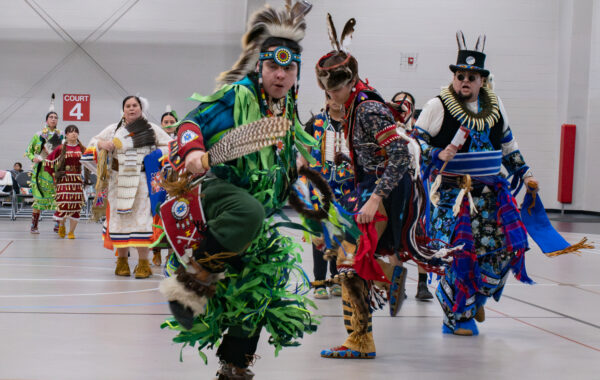
Gordon said INNR works to make Indigenous perspectives more visible on campus through events, including the annual Ptaŋyétu Powwow that CSB+SJU hosted this year on Nov. 7, as well as student research and service opportunities.
Students interested in continuing their education about Indigenous communities can also pursue courses such as Native Health and Wellness (SOAN 337V) and Teaching Native Histories and Cultures (EDUC 309), both offered during the upcoming spring semester. Additionally, Gordon explained that INNR regularly hires students, and urges anybody interested to look for a job ad from INNR this spring.
Minnesota is home to 11 federally recognized tribes, and Gordon said CSB+SJU’s location in central Minnesota provides opportunities for the colleges to build relationships with the state’s diverse Indigenous communities.
For Gordon, Native American Heritage Month should extend beyond learning about Indigenous history.