
Expert discusses ‘racial paradox’ of the Midwest
The CSB+SJU History Department and Multicultural Center teamed together to invite Ashley Howard, assistant professor at the University of Iowa to present the Black History Month keynote address. Howard spoke on the history of racial equality in the Midwest and shared her work on unraveling racial unrest.
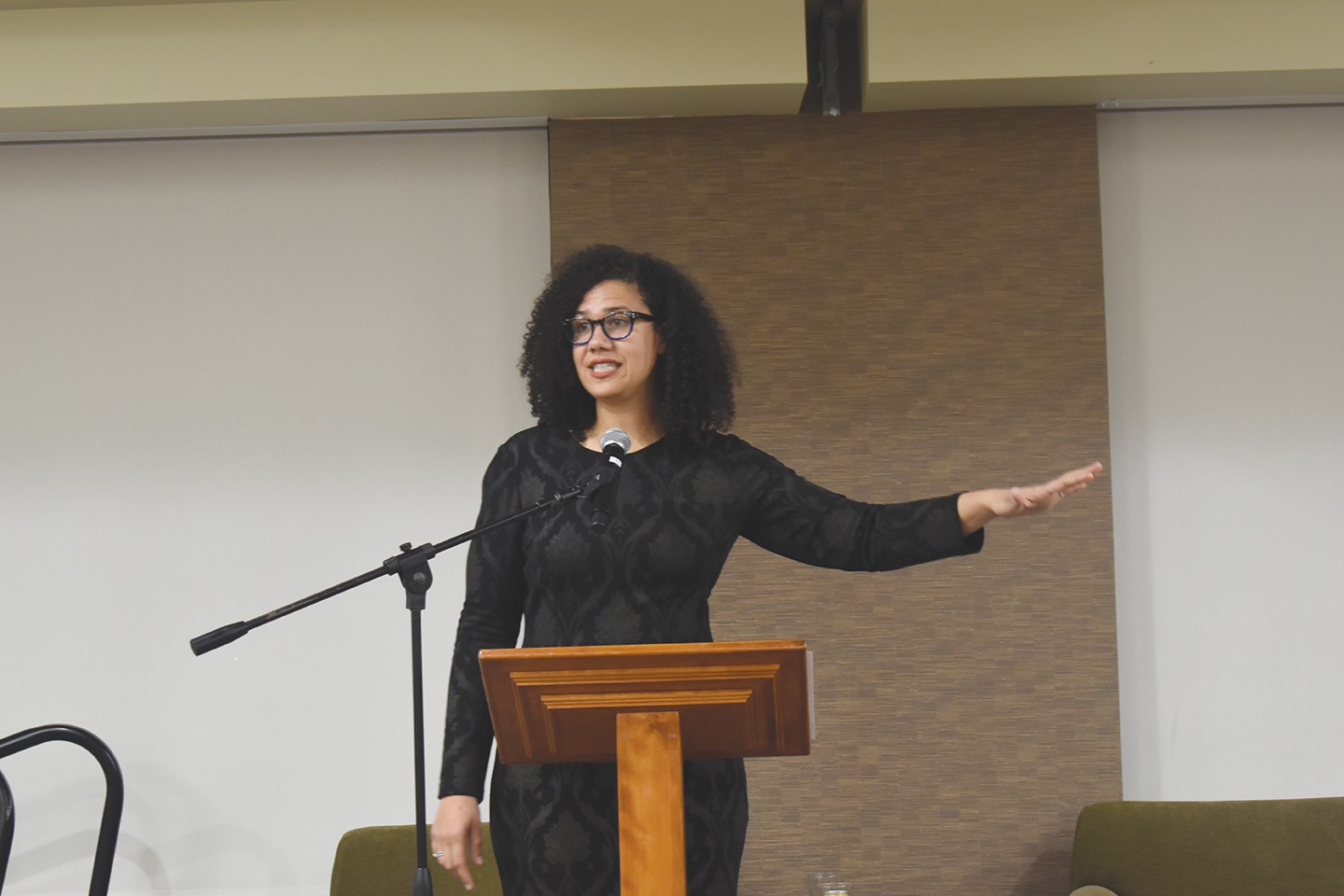
To celebrate Black History Month, the CSB+SJU History Department and Multicultural Center invited Ashley Howard, the assistant professor of history and African American studies at the University of Iowa, to speak on the history of racial equality in the Midwest.
“The 21st century Midwest is a racial paradox,” Ashley Howard said on Thursday evening at the Black History Month keynote address. “Metropolitan areas like Des Moines, Madison and Minneapolis regularly rank high and often highest on ‘best places to live,’ while being amongst the lowest in markers of economic and social parity for black residents.”
The audience filled every seat in Upper Gorecki to hear from Howard as she shared her work unraveling political and racial unrest within the historical Midwest.
Howard began by introducing herself as a “proud, black Midwesterner.” Howard’s areas of study include black Midwest social movements and the global history of violence. During her presentation, she conceptually broke down historical riots, protests and injustices while constructing a concrete definition of the Midwest, including a total of 12 states—Minnesota included.
“Put simply, we can’t think of the Midwest as America’s backyard where it keeps us innocent,” Howard said. “If we consider the experiences of people of color in this region for the past 200 years, if we buy the myth that the Midwest is an exclusively white place without race problems, then there is no issue to manage.”
Brittany Merritt Nash, CSB+SJU assistant history professor, highlighted how important Howard’s work is to listen to.
“Learning more about the ‘Black’ Midwest or the ‘African American’ Midwest is part of learning about our own history and identity as people who live in central Minnesota,” Merritt Nash said. “By expanding the scope of how we understand the Midwest, who lives here, and how we got to where we are today is important for everyone.”
At the conclusion, Merritt Nash hosted a Q&A session with Howard on stage to facilitate further discussion, especially in the context of the racial covenants project done by CSB+SJU students. In the spring of 2023, Eileen Otto (CSB senior), Connor Veldman (SJU senior), Robbie Smith (SJU senior) and Olivia Schleper (CSB ’23) conducted a research project on historical and existing racial covenants within the greater St. Cloud area. The group of students revealed a continuing existence of racial covenants upon property in the area, restricting citizens of color from purchasing or owning land in designated geographic locations. The four students worked alongside Merritt Nash and the topic of their project aligned with the work of Howard, who is currently conducting similar research in Iowa, to reveal racial injustices.
St. John’s student Marcus Hayes felt that the event with Howard aligned well with the current unrest of the student senates. During the spring of 2023, he voiced his disappointment with both senates for their failure to advocate for students of color in the CSB+SJU community. At the St. John’s Senate meeting on Monday evening, Hayes was among a group of more than 20 CSB+SJU students who gathered to protest the meeting, addressing concerns of racism and poor leadership on the senate’s behalf.
Having had the opportunity to share lunch with Howard earlier in the day, Hayes shared his excitement for the evening’s event and the importance of the subject matter for community members to learn and grow from.
“Something the senators said is that they’re going to change and are willing to change,” Hayes said. “If they come, it’s going to open their eyes, and it will be interesting to see who shows.”
At the event, St. Ben’s Senate president Clair Moonen and Sen. Roselyn Meza, current decolonization, reparations and justice representative, shared their excitement for all that Howard had to share with the audience.
“It is very important to see all of the different students from different cultures and backgrounds coming together as the CSB+SJU community,” Meza said. “We come together just to support one another.”
The positive turnout for the event on Tuesday evening matched what Hayes, Moonen and Meza had hoped. Howard concluded with remarks, encouraging the community to ask, “What’s next?”
“What I’m asking us all to do is reconcile, redefine and reinterpret the multiple ways of being Midwesterners, by specifically putting this regional identity in conversation with a multitude of racial class and gender identities,” Howard said.