
Don’t wait, take action when it comes to your health
This is the opinion of Landon Peterson, SJU senior.
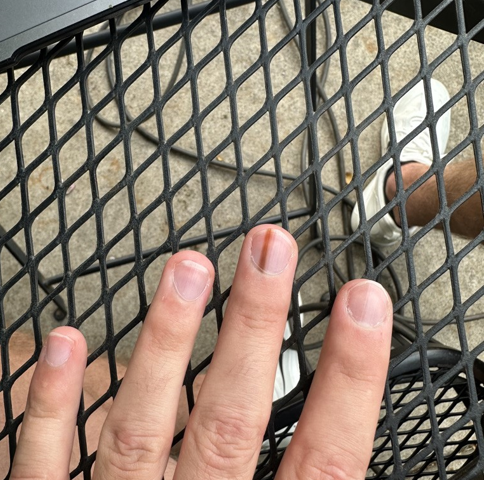
Earlier this year, I was diagnosed with a melanoma (skin cancer) on my finger and faced the easiest decision of my life: have surgery to remove the melanoma or let it be and watch the cancerous cells take over my body.
Hopefully that’s enough of a start to draw you in. I don’t usually like talking about myself in The Record, but the rest of this column is devoted to my story with the hope that it helps someone, somewhere if necessary.
Late last spring, I noticed a dark brown line running vertical on the fingernail of my left middle finger. It seemed like it just appeared out of nowhere, and because it didn’t hurt and wasn’t bothering me, I shrugged it off and went on with my life.
It took my mom a couple of weeks once I got home for the summer to notice this line and ask what the heck it was. Of course, she did what moms do (worry) and texted a family friend who happens to be a doctor.
After sending the picture over, I got a response: “Hi Landon—though I think it’s probably nothing bad or dangerous, it would be good to have a dermatologist look at this and make sure they don’t need a biopsy.”
OK, got it—off to the dermatologist I went. He quickly determined that the brown line was the result of a mole at the top of my fingernail that was leaking pigmentation down the underside of my nail.
What did that mean? That a biopsy was necessary. For those who don’t know (I didn’t), a biopsy is when you have a sample of your tissue removed so that someone can examine it for disease. In my case, I had to get what’s called a punch biopsy, where they literally took a chunk the size of a hole punch, which also involved removing my fingernail (sorry to those of you with weak stomachs).
All the while, the dermatologist assured me that it was probably nothing. My fingernail would grow back, etc.
Well, the biopsy results came back, and it was stage 0 melanoma—essentially, melanoma that has not spread below the surface of the skin. They caught it as early as possible, which is a great thing because once melanoma spreads, it spreads fast.
What this meant for me, though, is that I had to have surgery to remove the cancerous cells and everything around them. I’m lucky that I didn’t grow up 50 years ago, because they would have just chopped my finger off at the first knuckle (I’m not joking). Because medicine has advanced so much, instead they removed a solid chunk of tissue from the top of my finger (essentially taking out my entire fingernail bed and then some), and then took skin from my hip to fill in my finger.
Today, I’m left with a still gnarly but pretty decent-looking finger. I’ll never have a nail there again (if you’re into the medical side of things, they took out every cell capable of producing a fingernail), so I’ll have a fun fact for the rest of my life. Compared to the alternative, my story is a happy one.
Why tell you all this?
Because one in five people who live in the United States will develop some form of skin cancer in their lifetime. Every eight minutes, someone in the U.S. is diagnosed with melanoma (the deadliest form of skin cancer). More people are diagnosed with skin cancer each year than all other cancers combined. Minnesota has an incidence rate of 27.9 per 100,000 people. And the incidence of people under 30 developing melanoma is increasing faster than any other demographic group. (If that’s not enough facts for you, I don’t know what is).
Don’t be like me and shrug off a weird brown line that appears on your nail or a weird mole somewhere on your body. If my mom hadn’t seen it, or if our doctor friend hadn’t suggested going to the dermatologist, or if the dermatologist hadn’t decided to do a biopsy, I would probably be in a much different situation right now.
I could tell you that there are some quality action steps to increase your chances of never developing melanoma: use sunscreen, don’t get sunburned, reduce your sun exposure, cover up or seek shade when exposed to the sun for long periods of time and watch the UV index. I should also add that young people who regularly use tanning beds are eight times more likely to develop melanoma than people who have never used them, while young people who occasionally use them triple their chances (a true and absolutely horrifying statistic).
But, since I’m writing to a bunch of college kids who sometimes (often) do what they want regardless of the impact it has on their health (#freedom), I’ll say live your life—but consider this: Take a look at your skin every once in a while.
Dermatologists use the ABCDE test: Asymmetry (most melanomas are asymmetrical), Border (melanoma borders tend to be uneven and may have scalloped or notched edges), Color (if you see anything other than a consistent, single shade of brown, go get checked out), Diameter (anything larger than about 6 mm, roughly the size of a pencil eraser should get looked at) / Dark (melanomas are sometimes a darker shade than the other moles on your body), and Evolving (any change in size, shape, color or elevation, or if a mole has a new symptom, such as bleeding, itching or crusting, may be a warning sign).
Even if you aren’t in the sun (or God forbid, using a tanning bed), still give yourself a quick onceover. My melanoma wasn’t the result of sun exposure; it was just random. And remember, melanoma is not just a skin cancer. It can develop anywhere on the body—eyes, scalp, nails, feet and mouth.
I’m not writing this with the intention of trying to scare you, and hopefully it has not had that effect. Rather, the point I’m trying to make is that we are adults now. It’s your responsibility to take ownership of your health and make sure you are doing OK, and this is part of that. Learn from my mistake and don’t shrug something off—get it checked out instead.