Luncheon held with Gov. Walz
The Economics Club of Minnesota held their November Luncheon.
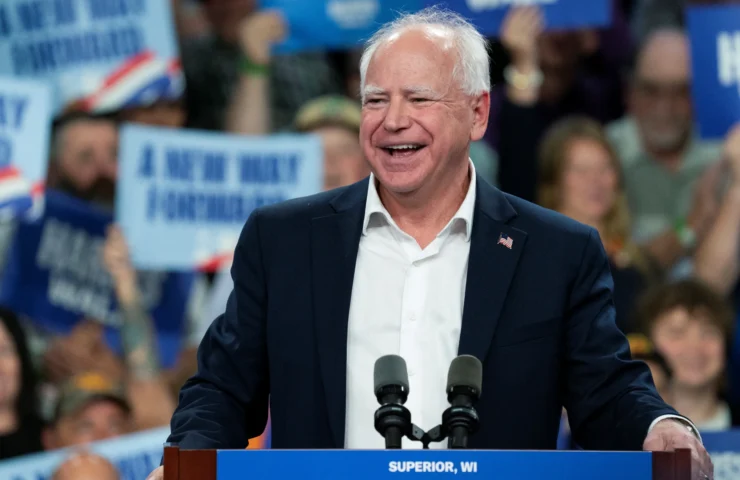
On Monday, Nov. 16, the Economics Club of Minnesota hosted its November Luncheon, featuring a conversation between Gov. Tim Walz and Tim Penny, Chair of the Economics Club of Minnesota and former U.S. Representative of Minnesota’s 1st Congressional District. As a Student Scholarship Partner School, the College of St. Benedict and St. John’s University— through the coordination of the Eugene J. McCarthy Center for Public Policy and Civic Engagement— provided students with the opportunity to attend the Economics Club of Minnesota’s programming. The November luncheon followed the tradition of Bennies and Johnnies attending such programs, with nine Bennies and Johnnies traveling to Minneapolis for Monday’s event.
Seated in the Metropolitan Ballroom, students heard Gov. Walz discuss Minnesota’s position in global trade. With one of the most diverse state economies in the nation, home to numerous Fortune 500 companies, and a hub of advanced manufacturing, medicine, tech and agriculture, Minnesota holds an important position in the global economy. Walz, who joked about having just returned to the state following a visit to Antalya, Türkiye, for the 31st Conference of the Parties to the UN Framework Convention on Climate Change (COP31), is no stranger to the work of international diplomacy, particularly when it comes to visiting global partners in search of collaboration, investment, and furthering ongoing trade negotiations.
Over the nearly hour-long luncheon, Penny and Walz traced Minnesota’s involvement in global trade during Walz’s tenure as governor. From visits to Sweden, the Netherlands, Iceland, Canada
and beyond, Walz and his administration have emphasized ensuring Minnesota remains a hub of industry and business at both the national and international levels by prioritizing relationships with foreign partners. Walz differentiated this approach from other methods of international trade, arguing that, given Minnesota’s cultural background, the state is positioned to do the critical work of relationship-building rather than merely cultivating transactions. He described the importance of such partnerships as Minnesota navigates its sub-federal role in trade relations, particularly amid shifting federal approaches to international trade.
While the students entered the luncheon with a general understanding of Minnesota’s position in global trade, the scope of its influence surprised them.
“I was surprised to learn just how much Minnesota is leading the way in important areas like sustainability and international relations,” SJU freshman Christopher Watters said. “It was great to see our state standing out in a positive way, especially with everything that has happened here recently.”
The discussion also highlighted the complex, at times precarious, nature of international trade and the importance of understanding the relationships that sustain it. As Walz and Penny illustrated, while classroom instruction provides an important foundation for understanding global economics, opportunities to engage directly with policymakers offer students a different perspective on how these relationships operate in practice. The luncheon emphasized that engaging with global economic issues requires firsthand experiences and an intentional focus on how different actors can support one another. This emphasis on experiential learning resonated with many of the students in attendance, who viewed the luncheon as an opportunity to extend their understanding of international relations and state economics beyond the classroom.
“The chance to learn about Minnesota’s economic policy directly from Gov. Tim Walz was an invaluable opportunity,” CSB senior Cecilia McNair said. “Sitting in the same room as consulates and other important international actors, discussing the role that Minnesota has as a player in the global economy made it clear that no matter who runs the federal government, Minnesota strives to continue building strong relationships with countries around the world.”
Recognizing the value of opportunities that connect classroom learning with real-world experiences, the McCarthy Center continues to partner with the Economics Club of Minnesota to ensure Bennies and Johnnies can hear from state and national policymakers, economists and business leaders. While the partnership emphasizes economics, student participation in the Club’s programming remains interdisciplinary, bringing together students from a variety of academic backgrounds. Students in attendance on Monday included majors in political science, English, economics, environmental studies and more. Through these opportunities, students can engage with the people shaping the conversations they study in the classroom and carry those conversations back to campus.
“I left the event with a greater appreciation for the work Minnesota is doing, and the impact our state can have beyond its borders,” Watters said.