The Conspiracy and the Candidate: a fragile democracy in “The Manchurian Candidate”
In the fall of 1962, as the Cuban Missile Crisis brought the world to the brink of nuclear war, “The Manchurian Candidate” emerged as an
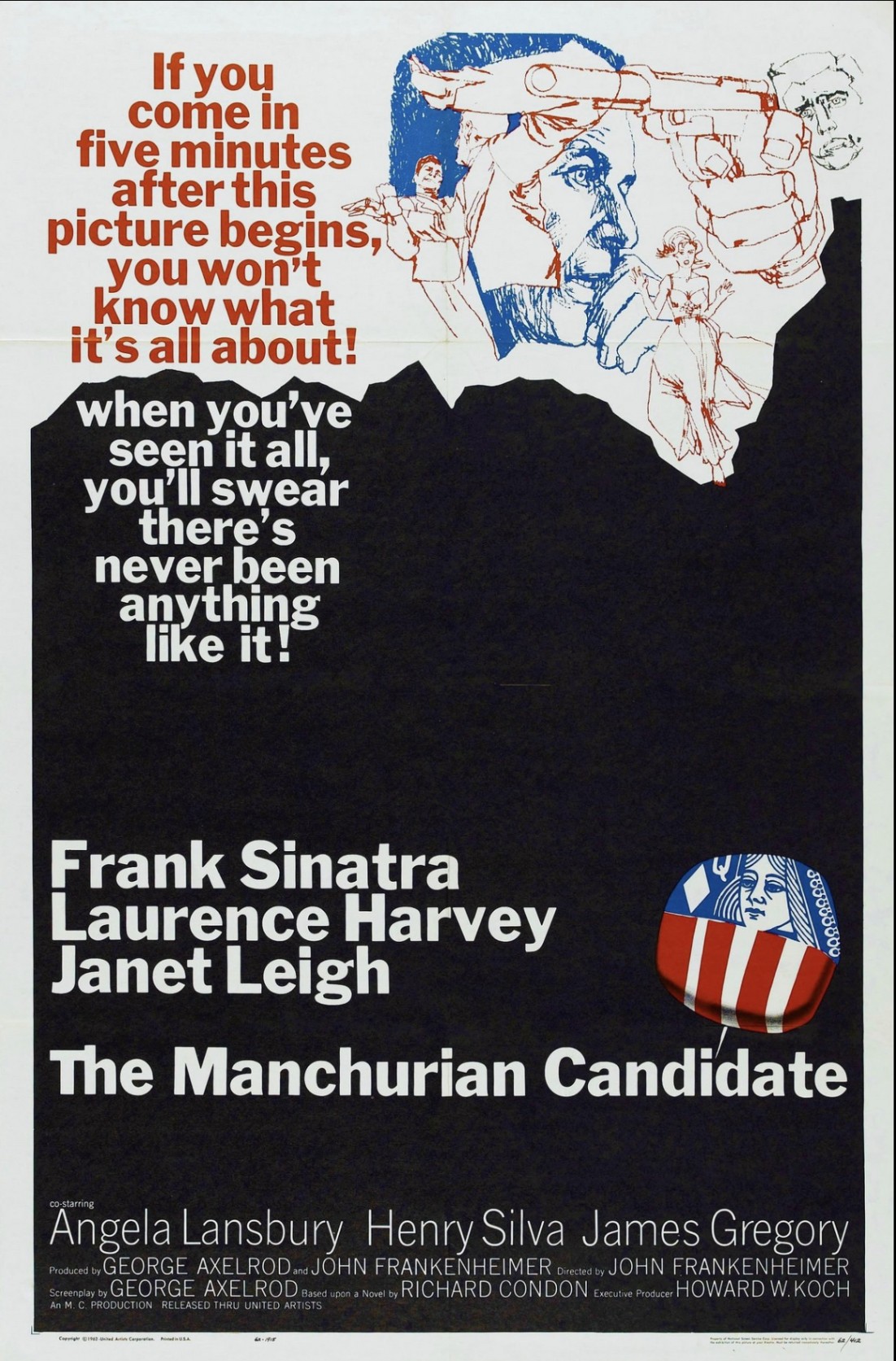
In the fall of 1962, as the Cuban Missile Crisis brought the world to the brink of nuclear war, “The Manchurian Candidate” emerged as an unexpected mirror to the anxieties of its time. Released on Oct. 24, just days after Kennedy announced the naval quarantine of Cuba, John Frankenheimer’s film captured the paranoia and fear of a society grappling with Cold War-driven fears of brainwashing and conspiracy.
Based on a novel by Richard Condon, and featuring powerhouse performances by Laurence Harvey, Janet Leigh, Angela Lansbury and Frank Sinatra, the film effectively captured the spirit of a society on the brink and a people with heads and hearts filled with Cold War anxiety and paranoia, a moment when political conspiracy theories had become accepted as truths, and deeply socially ingrained fears began to shape national policy and public discourse.
“The Manchurian Candidate “follows U.S. Army Major Bennett Marco (Sinatra) as he pieces together a conspiracy so insidious that it defies belief. His former platoon sergeant, Raymond Shaw (Harvey), a man celebrated as a war hero, is frankly no hero at all, for he is, in truth, only the carefully conditioned product of a foreign plot, an assassin in waiting. Behind it all stands one of the most chillingly portrayed figures in political fiction, Shaw’s mother, Eleanor Iselin (Lansbury).
Eleanor is an undercover communist agent who moves with meticulous precision, using her husband, the blustering McCarthyist demagogue Sen. John Iselin, as a willing but oblivious instrument. The Senator bellows about the active involvement of a “Red Menace” plotting to ruin America from within to stoke public hysteria while thriving on reckless, unfounded accusations — each day spewing out an ever-inflating number of communists he had identified in the US Senate and continuously proclaiming to on the verge of exposing it. His crusade is no act of patriotism — it is a carefully orchestrated distraction, a product of Eleanor’s careful orchestration. While the country fixates on imaginary enemies, Eleanor works toward her real objective: the systematic infiltration and destabilization of the American government. In that, she is shrewd, if cold, calculating and utterly ruthless, having transformed her husband, the McCarthyite Senator, into an instrument — with surgical precision, she infiltrates the American political machine, setting the stage for a coup that will shake the foundations of democracy itself.
The plan is to elevate John Iselin to the vice presidency, then arrange for the assassination of the presidential nominee, ensuring his immediate and uncontested rise to power. The mechanism is already in place: Raymond Shaw is conditioned to kill without hesitation, waiting only for the right command. Through him, Eleanor does not merely seek control of an administration — she seeks control of the very fabric of American democracy, twisting its institutions into instruments of her own design.
In “The Manchurian Candidate,” the enemy does not march across borders or attack from distant shores. The enemy infiltrates, manipulates and uses the very machinery of democracy to dismantle it from within.
The film’s exploration of conspiracy, manipulation and the fragility of democracy feels eerily relevant in today’s political climate. In an era where conspiracy theories have crawled into mainstream political discourse, “The Manchurian Candidate” serves as a cautionary tale. Populist leaders like Donald Trump and Viktor Orbán have weaponized conspiracism, using narratives of the “deep state” to delegitimize opponents, rally their base and shield themselves from accountability, deflecting any criticism. These tactics, much like Eleanor’s manipulation of anti-communist hysteria, exploit fear and distrust to consolidate power. The film’s warning about populist demagoguery, the dangers of normalizing conspiracy discourse and the erosion of democratic norms resonates deeply in a world where truth is increasingly malleable and democratic institutions are under threat.
At its core, though at times zany and overtly Freudian, “The Manchurian Candidate” is more than a Cold War thriller; it is a thorough exploration of how power can corrupt, how fear can be weaponized and how the greatest threats to democracy often come from within