
International exhibition has campus connection
When I arrived on campus for the very first time in August 2023 as an international student from Hungary and the Netherlands, I was surprised
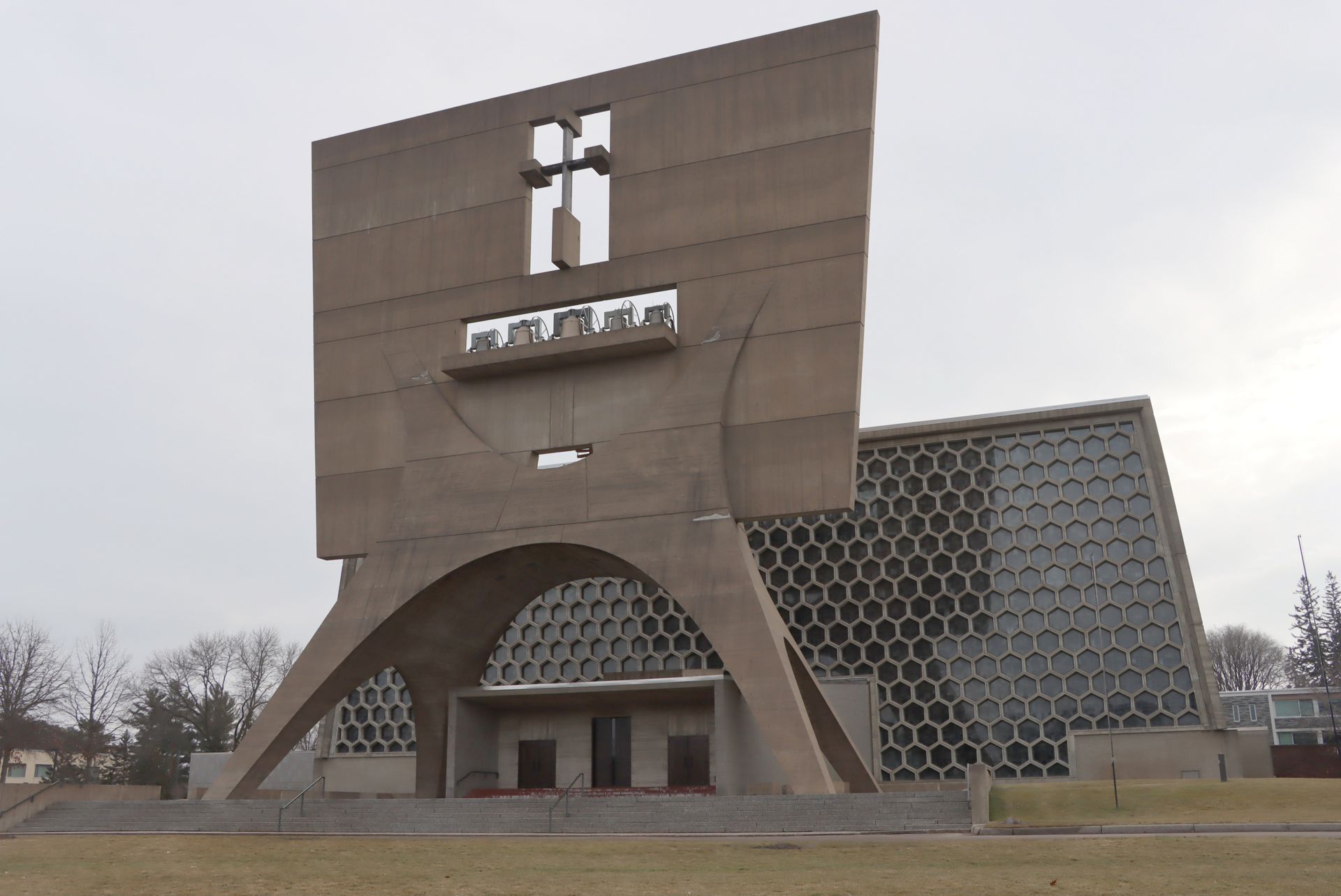
When I arrived on campus for the very first time in August 2023 as an international student from Hungary and the Netherlands, I was surprised by the beauty of the campus and the Abbey Church.
I was impressed by the Abbey’s architecture and the appearance it had. A couple of months before coming to campus, my grandma had figured out that the Abbey, along with several other buildings on campus, had been designed by a Hungarian-born American architect and designer named Marcell Breuer. I, as a Hungarian/Dutch person, had unknowingly chosen a university with a Hungarian connection. What are the chances?
As for Breuer, at a young age he joined Bauhaus (a world-famous institute for art and architecture). Walter Gropius, the Bauhaus director, convinced him to focus on carpentry and architecture. Not long after, Breuer quickly established himself as a star student and Walter Gropius’s favorite, and in 1924, Breuer became the youngest teacher on the Bauhaus faculty. Soon came a pivotal moment in design history: the then only 23-year-old Breuer was the first person in the world to make furniture using bent metal. His revolutionary designs are classics of modern furniture today, filling design museums around the globe.
After establishing himself as a highly rated designer and architect, Breuer went on to construct more than 70 buildings all around the world including the UNESCO Building in Paris, the headquarters of IBM, the Whitney Museum in New York and, of course, the various buildings on the St. John’s campus such as the Monastery Residence Building (1955), the Abbey Church (1958), the Warner Palaestra and the Warner Palaestra Sculpture (1973) and various other buildings. If you look at these buildings on campus or online, you will notice that all these buildings are built in a very brutal way. Breuer became the leader in the so-called brutalist movement which favored raw, exposed materials that were used for these massive institutional projects. But what is the meaning behind this brutalist movement?
While on Christmas break with my family in Hungary, I took the opportunity to visit the Breuer memorial exhibition “Sence and Remembrance” of Marcell (Lajkó) Breuer that finally opened 40 years after his passing. The exhibition is located at his birthplace in Pécs, in the South of Hungary close to the border with Croatia and Serbia.
The exhibition showed the connections between his style and the relationship between a cosmopolitan person and a Hungarian. The exhibition included models, drawings and photographic documents of Breuer’s most famous buildings, as well as artifacts, documents and furniture.
The exhibition also included St. John’s University with the Abbey Church in miniature form and other pictures of the Abbey itself. The Abbey reflected Breuer’s belief that “modest as it may be, a place of worship seems to demand dignity and serenity as its birth right. It is part of its function to reach beyond functions.” Its destiny seems to be to express in static material—stone, concrete, glass—man’s drive towards the spiritual. The inanimate structure reflects the vibrations of his thoughts, of his emotions, of his beliefs. The sober science of building and engineering must achieve more than a routine solution—it must receive demonstrative and symbolic dimensions. World famous architect I.M Pei even once said that if the Abbey Church was not tucked away in central Minnesota, it would be one of the 20th century’s most famous pieces of architecture.
Altogether, I just want to say that CSB+SJU is very special campus that is much more than just a college in central Minnesota: it connects with the whole world. And maybe when you are visiting Hungary (which you should), someone might end up knowing the college you are going to.