SJU and St. Joseph hold precinct caucuses
SJU and St. Joseph held precinct caucuses for the Democratic-Farmer-Labor and Republication parties, respectively.
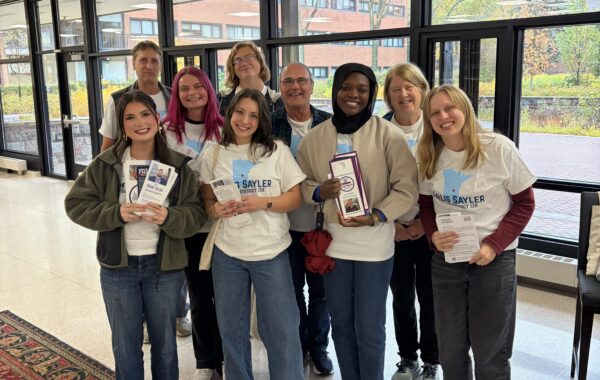
For students looking to get more involved in the U.S. political system, a prime opportunity arose on Feb. 27 as precinct caucuses were held on both campuses and in St. Joseph.
SJU senior Evan Mattson and CSB first-year Cecilia McNair chaired Democratic-Farmer-Labor caucuses at SJU and Kennedy Community School in St. Joseph, respectively, while SJU first-year Ben Bugbee chaired the Republican caucus held at Sal’s Bar in St. Joseph.
“It was a really good look at how local government works, starting right from the people and how things get started and can be brought to the House or the Senate,” McNair said.
Precinct caucuses are local events where members of a political party gather to discuss resolutions for the party platform and potential candidates for upcoming elections. Oftentimes, potential candidates introduce themselves at these meetings.
Bugbee, Mattson and McNair had around 10-20 people attend their caucuses. Mattson said nine SJU students and one St. John’s monk attended his meeting, while McNair said around eight Sisters of the Order of St. Benedict attended hers.
Caucus chairs are elected at the beginning of the meeting. In this position, Mattson, McNair and Bugbee directed the flow of the caucus conversation and kept the meeting on track.
“It’s a great way to encourage grassroots involvement,” Mattson said. “That’s what the purpose of the precinct caucuses is: to get the conversation rolling.”
These three caucuses were just a few of many held statewide for the Republican, DFL and Legal Marijuana Now parties on the 27th. For the DFL and Republican parties, district caucuses come after precinct caucuses. It is at these meetings that the parties endorse candidates for local elections.
CSB+SJU political science professor Jim Read, who served as the secretary of the Avon precinct caucus, stressed the importance of receiving a party’s endorsement for local races.
“In most state legislative races in Minnesota, whoever wins the party endorsement, which begins with the caucus process, ends up being the party’s nominee,” Read said.
Some district caucuses have already taken place. The DFL caucus for some of St. Joseph is scheduled for this upcoming Saturday at Kennedy Community School, which McNair plans to attend.
Mattson and McNair said Read encouraged their participation in the caucuses, while Bugbee said he was elected to be a Congressional and State delegate in years past.
“I’ve always had a deep interest in politics. I’ve gravitated to this type of stuff for a long time,” Bugbee said. “The precinct caucuses are really how the sausage is made. This is how we determine the candidates that go forward, for better or for worse.”
Each student who chaired a caucus spoke about the importance of partaking in local government dialogue and voting.
“I always think it’s hard for people to criticize the way that things are going in the world if they haven’t made a choice to do their part and vote or go to a caucus and do something,” McNair said. “I think that’s really important.”
Precinct caucuses weren’t the only political event to take place in the past few weeks. Minnesota’s presidential primary took place over spring break on March 5. For students living on campus, these were held at the Collegeville Town Hall, Avon Town Hall or St. Joseph Government Center.
As of now, it appears the nation is headed for a rematch of the 2020 election between current President Joe Biden and former President Donald Trump.
According to the Office of the Minnesota Secretary of State, Trump finished first in the state’s Republican primary, followed by former South Carolina Governor Nikki Haley. Trump received 68.94 percent of the votes, while Haley received 28.77 percent.
Although Trump may be on his way to securing the nomination, not all Republicans are excited about his candidacy.
“The Republican Party has always tried, in my opinion, to be the party of the moral high ground—the party of values, of tradition, of community—and [Trump] just does not, in his own being and in his conduct, represent any of those,” said Bugbee, who is working to restart the College Republicans club on campus.
For the Democrats, Biden received 70.12 percent of the votes, far ahead of Minnesota Representative Dean Phillips’s 7.76 percent. However, 18.8 percent of Minnesota voters submitted “Uncommitted” for their vote.
“President Biden had Dean Phillips and Marianne Williamson [running against him], but those were long shot candidates,” Mattson said. “When you have an established candidate, it’s very uncommon that you see an incumbent lose the primary for president.”
According to Morgan Van Beck, CSB senior and co-leader of the College Democrats, many students aren’t excited about the prospects of a Biden-Trump rematch.
““It feels most disappointing because an election should be a time of striving for ideals and not choosing between the lesser of two evils, and that’s how it seems like a lot of people are looking at it this year,” Van Beck said.
Despite this, Read said voting remains as crucial as ever.
“It’s not just whether you personally warm up to one or another of the presidential candidates,” Read said. “It’s about what kind of future you want to have for yourself and for your families and your kids.”