Speaker gives talk on soft lingustic terrorism
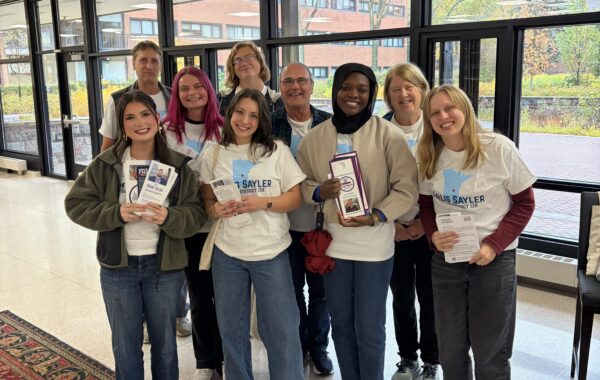
Researcher and assistant professor from Brooklyn College, Mike Mena spoke at the event hosted by the Hispanic Studies Department in Upper Gorecki.
CSB+SJU students and faculty had the chance to gather in Upper Gorecki for an event hosted by the Hispanic Studies Department on Tuesday.
Mexican researcher and assistant professor at Brooklyn College (CUNY) Mike Mena spoke on soft linguistic terrorism that is taking place around the world.
Mena has published work in various peer-reviewed journals, which include the Journal of Linguistical Anthropology, Language and Society and Educational Linguistics.
Mena’s work and research earned him the Society for Linguistical Anthropology’s Intellectually Informed Public Activism Award in 2019 and the Carnegie Educational Technologists Fellowship in 2021. His presentation covered many topics, ranging from sharing his own personal stories to defining soft linguistic terrorism.
“Language is tainted by culture, race, ethnicity and gender; we tend to believe that some people speak standard language while others do not,” Mena said.
Mena said that due to linguistics, languages can take many forms. For example, there are many versions of English, such as Spanglish and broken English.
“These are all ways to fail at achieving this thing called standard language, or producing this thing called standard language, but we must remember, standard language does not actually exist,” Mena said.
Mena then discussed linguistic terrorism, a theory that Chicana theorist Gloria Anzaldúa helped identify in the 1980s.
The linguistic terrorism theory describes racist attacks on supposedly non-standard linguistic practices. People with these linguistic differences were often seen as inferior to people who spoke idealized English or Spanish.
Mena made it clear this provides some context but pointed out that times have changed. “We are not in the 1980s anymore, and discrimination looks different in the 2020s,” Mena said. Mena also differentiated between critique and criticism and focused on critiquing practices that lead to soft linguistic terrorism.
Before Mena defined soft linguistic terrorism, he shared a personal experience. “When I was a 21-year-old teacher, I would venture into almost racist practices as a teacher, but this is about growth and moving forward to be better about the practices we do,” Mena said.
Mena’s personal stories eventually transitioned into his definition of soft linguistic terrorism.
“The New School linguistic terrorism, the soft diplomacy terrorism, uses softer methods of racial and linguistic governance,” Mena said. “By the word soft, I am invoking the specter of political soft power, which does not work through direct war and conquest, or more so through incentives and institutional leverage.” Mena connected this concept to the modern world.
“In Ukraine, we are not putting troops on the ground—that would be a direct expression of power—but we may be feeding intelligence on the side or trying to bankrupt Russia, which are seen as soft power techniques,” Mena said.Hispanic Studies professor Tania Gomez invited Mena to present because Mena’s work would encourage reflection among the institution.
“As in many other institutions, we are not freed of racist acts that sometimes are invisible to us. Dr. Mena’s work on language delegitimization via ‘linguistic terrorism’ allows us to—perhaps—reflect and/or understand how this ‘terrorist’ act mostly enforces idealized white, middle-class, monolingual social norms,” Gomez said via email.
For those who could not attend the event, Gomez provided a long-term lesson about linguistic appreciation.
“In the long term, linguistic shame and guilt need to be replaced by linguistic pride. Embracing and harnessing different languages and language varieties can be a win-win situation achieved by building solidarity instead of sharpening distinctions to the detriment of minoritized groups,” Gomez said.