First female Lt. Gov. visits
Marlene M. Johnson, Minnesota's first female Lt. Govenor, visited both the CSB and SJU campuses on March 4. She spoke about her journey to success and her experiences as a local woman trailblazer in the 1980s.
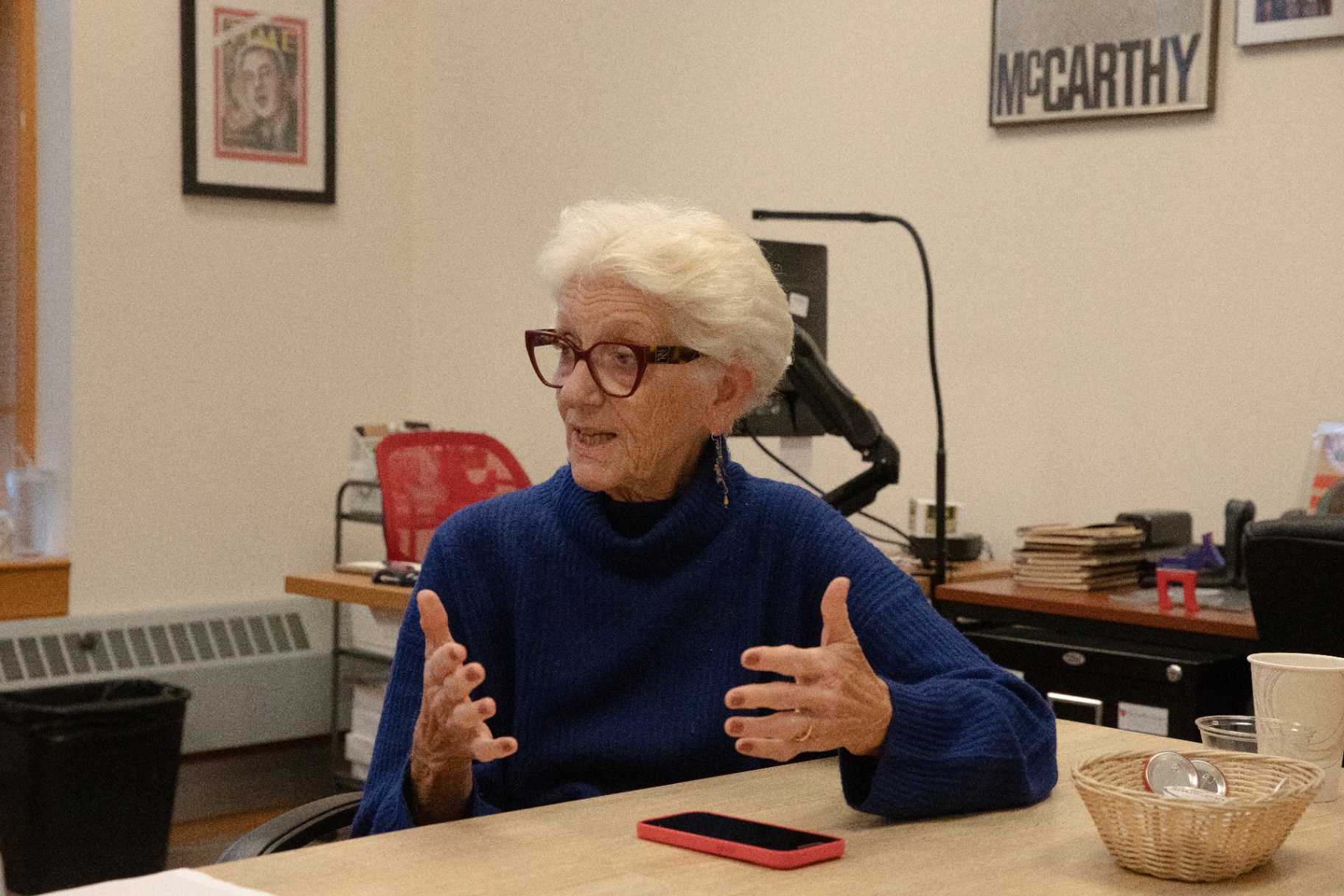
Minnesota’s first female Lt. Governor, Marlene M. Johnson, paid both campuses a visit on Wednesday, March 4.
Her appearance was part of an event hosted by the Eugene J. McCarthy Center for Public Policy and Civic Engagement called “Conversations on Public Leadership and Resilience.”
The event was held throughout the day in a series of conversational “roundtables” at CSB+SJU.
Intended to engage students and all those interested in making an impact, this event was an opportunity to hear from a local trailblazer for women in leadership.
Students were able to hear from Johnson’s experiences in breaking political barriers, leading with purpose and navigating personal resistance.
Johnson, who grew up in Braham, Minnesota and graduated from Macalester College, took on leadership early in her life, although it wasn’t a straight path.
“I couldn’t get a job at first, so I ended up working in a factory for a while, just to pay the bills,” Johnson said.
At 37 years old, she became Minnesota’s first female Lt. Governor, serving from 1983 to 1991 alongside Governor Rudy Perpich.
In a time when women were rarely in executive political roles, it was common for the accomplishments of the women who were in those roles to be neglected or attributed to those they worked for.
Published in 2024, Johnson’s book, “Rise to The Challenge: A Memoir of Politics, Leadership, and Love”, works to bring light to her role in shaping public policy, the journey she took to get there and the life that followed.
Starting with campaigning for her high school to add foreign language instruction to the curriculum, she took this spirit with her into office and leadership roles that followed.
After office, Johnson cofounded the Minnesota Chapter of the National Association of Women Business Owners (NAWBO) and the Minnesota Women’s Campaign Fund.
She also was an executive director and CEO of NAFSA: Association of International Educators, the world’s largest non-profit association dedicated to international education and exchange.
She spent 19 years with them, with 40 staff when she started and 1000 when she left.
Johnson shared how often people are unaware of their own influence, sharing her own experience.
“In a million years, even though I had done all the organizing, etc., it never would have occurred to me that I was going to be leading the organization officially,” Johnson said, referring to her leadership at NAWBO. “I was just doing what had to be done.”
Through all this work, Johnson shared she was most proud of her work integrating women and people of color in the state government and judiciary, especially regarding her role in the appointing of Harriet Lansing, one of two female judges on the Minnesota Court of Appeals, who served until 2011.
“She ended up being the most brilliant jurist on the appellate court, and the longest serving member of those original appointees,” Johnson said. “And if I hadn’t been there, who knows?”
Students who attended the event shared their gratitude at having such an influential person share their insight.
“It’s really cool that our campus is bringing women that have had such a lasting impact on Minnesota,” said CSB junior and event attendee Siena Maciej. “To see what kind of legacy people are leaving, and how that inspires the next generation of people… that’s something I want to focus on, because it was something that previous people worked so hard to create.”
Students said that celebrating the success of women in leadership roles is one way to highlight the important contributions that women have made in society, but it is not the end of the conversation.
Although women compose half of Minnesota’s adult population, they hold only 25% percent of leadership positions across the state, accounting for the average across business, government and nonprofit leaders, according to the Minnesota Compass website.
This number becomes significantly slimmer when looking at women of color.
According to Johnson, leadership stretches far beyond politics and can be seen in everyday college life and post-graduation.
“The most important thing is just to get started… The first job doesn’t have to be a win,” Johnson said, reminding those at the event that persistence is essential. “Eventually one learns about oneself, what one is good at, what gives you joy and what gives you excitement.”