
34th annual Peace Studies Conference discusses climate change
Dr. Cheryl Holder, president of the Florida State Medical Association, advocated for comphrehensive medical prevention and care strategies for poor communities impacted by climate change. COP27 students presented their climate research prior to Holder's talk.
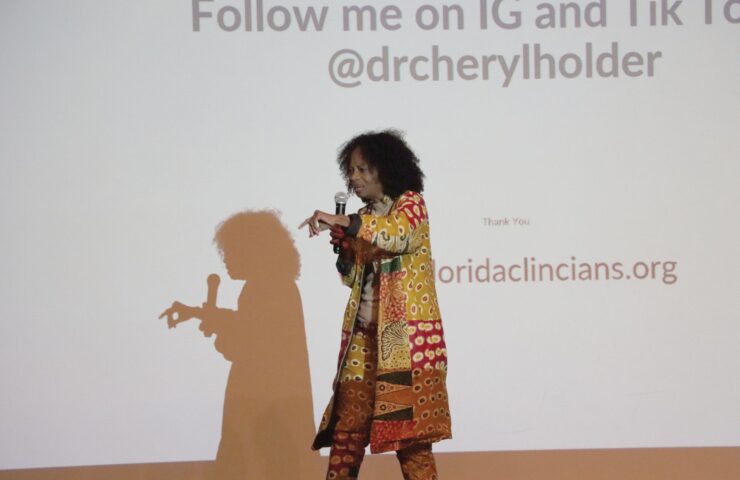
On Oct. 16, students and faculty came together in the Pellegrene Auditorium to learn about how climate change is affecting people’s health.
Dr. Cheryl Holder was the speaker of this event, which took place as part of the 34th annual Peace Studies Conference along with a student panel on global climate action.
In her speech, Holder discussed the importance of addressing the social determinants of health, such as poverty, discrimination and access to resources, to achieve equitable health outcomes. She also talked about the impact of climate change on health, especially for marginalized communities. Holder emphasized the need for systemic change in healthcare and society as a whole to ensure that everyone has the opportunity to live a healthy life.
Holder was born in Kingston, Jamaica, and raised in New York City. She is a graduate of Princeton University and George Washington University School of Medicine, a National Health Service Corp Scholar, Internist and HIV Specialist. Holder also served as medical director for Jackson Health System’s North Dade Health Center from 1990 to 2009.
In the New York City community that Holder grew up in, little girls would rollerskate and hitch rides at the back of the city bus. Holder explained how one day, one of the girls slipped back and landed on the pavement when the bus stopped abruptly. She said that neighbors waited with the girl for an ambulance, but one never came because of the neighborhood they were in.
“At the age of 10, I knew that this was not right. I knew there was something more we could do. The something I could do was become a doctor,” Holder said.
Holder explained how climate change data is showing allergy seasons are starting weeks earlier, nighttime temperatures are rising, trees are growing faster and mosquitoes carrying dangerous diseases like Zika and Dengue are showing up in new areas.
Holder said she is starting to see signs of climate gentrification in Miami-Dade, Fla., where she lives and works. Climate gentrification is when richer people move into poorer neighborhoods that are at higher elevations and less subject to flood damage from climate change.
Despite this, Holder said that the main concern of residents in Miami-Dade is the heat and not the sea level rising.
“People are mostly dying from the heat,” Holder said.
Holder shared patient accounts to further explain the direct effects of heat on health, mainly black and brown people from poor communities.
Patient Ana Mae brought a Florida Power and Light Form to Holder to sign. The heat was affecting the patient’s asthma severely and she was using her air conditioning to breathe more clearly. Another patient named Jorge was a fruit vendor. Jorge developed a kidney condition that was caused by working on the hot streets in Miami.
Patient Sandra Faye Twiggs with chronic obstructive pulmonary disease (COPD) was arrested after fighting with her daughter over a fan. When she was released from jail, she returned to her apartment with a non-stop cough and died three days later due to the heat.
Holder said these patients’ experiences prove the heat caused by climate change in Florida is becoming more and more dangerous and cannot be ignored.
“My patients have told you the truth,” Holder said. “Climate change is real.”
Dr. Holder said the groups whose health is most at risk from extreme heat include people with disabilities, the pregnant, the poor, the homeless, children, the elderly, outdoor workers and athletes.
“The richer you are, the healthier you are,” Holder said.
Holder also emphasized the importance of tackling the issue of climate change before it is too late. According to Holder, there are only seven years left to take action against climate change before it is impossible to do so.
CSB first-year Rhea Murphy, who attended the event, shared how the time we have left to take action shocked her.
“I knew it was soon. But I didn’t know it was that soon,” Murphy said.
CSB first-year Brooke Husmann said she will remember the event’s takeaway of how disease is currently spreading.
“Disease spreads so much easier with the climate crisis,” Husmann said.
The conference also included a student panel earlier in the evening before Holder’s speech presenting research on global climate action in the Founder’s Room at SJU. Panelists included CSB seniors Mahina Melim and Jalayna Smith-Moore, SJU sophomore Finn Dolezal and SJU seniors Tom Hobday, Fredi Ponce-Parra and Landon Peterson.
These students attended or will attend the United Nations Framework Convention on Climate Change (UNFCCC) annual Conference of the Parties (COP). Five of the panelists attended COP27 in Eygpt last year, and three will attended COP28 in Dubai later this fall.
The research projects the panelists presented on included topics such as youth activism and homeowners insurance as they relate to climate change. Panelists also took audience questions about how the COP trips have impacted or will impact them and their current and future endeavors. CSB+SJU are one of only two schools in Minnesota and one of the only schools in the country with a program that allows students this opportunity.
Holder ended her speech and the overall Peace Studies Conference with a call to action, encouraging the audience to be activists for climate change action in whichever way they can.
“We have enough solutions to slow the warming of our planet; what we need is more political will,” Holder said.