
Taking a shot at the violence of grief in “John Wick”
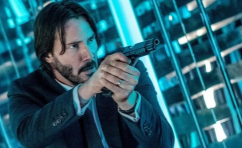
Keanu Reeves as character John Wick in the first installment of the “John Wick” movie series.
Being an English major is a lifestyle.
Ever since I started writing book and movie reviews last year, I’ve unintentionally found myself searching for the deeper meaning in the media I consume, which is exactly what I was doing over the summer while I was chudding out and watching movies with my boyfriend.
So, naturally, when we watched all four “John Wick” movies, I obviously couldn’t just watch (the very handsome) Keanu Reeves shoot probably hundreds of people and call it a day. I had to ask myself what it all meant.
On the surface, “John Wick” is a pretty simple revenge story. In the first movie (spoilers ahead), John Wick, a retired assassin, is mourning the death of his wife when he receives a puppy named Daisy, which was left to him as a final gift from her. The dog gives Wick something to care about while he grieves. Then Iosef Tarasov, the spoiled son of a Russian crime boss, decides that he wants Wick’s prized car, and of course Wick refuses to sell it. That night, Iosef and his friends find his house, steal his car and kill Daisy.
That last part almost made me quit watching.
The stolen car and especially the murdered dog send Wick back into the world of assassins that he had worked so hard to leave behind. From there, the movie becomes a beautifully choreographed, extremely violent revenge mission. Wick shoots, punches, stabs and otherwise eliminates basically anyone who gets between him and Iosef. It’s entertaining, visually appealing and it has a healthy amount of ridiculousness (e.g. pencils—if you don’t get that reference, watch the movies). However, underneath all of that violence, I believe “John Wick” is interested in the way men are taught to deal with grief.
Wick doesn’t really talk about his feelings. In fact, he barely talks at all. His wife dies, he gets a dog, the dog dies, and instead of finding someone to talk to, he digs up his guns and gets back to work.
That’s where the movie’s portrayal of masculinity becomes interesting. Wick is powerful because he is physically capable, emotionally cold and feared by everyone around him. His reputation as a killer is essentially his identity. He doesn’t have to explain himself or prove that he’s angry. People hear his name and immediately know what he is capable of.
His grief is almost entirely communicated through action. Instead of openly expressing how much he misses his wife, his sadness turns into anger, and his anger turns into violence. The movie plays into a familiar idea of masculinity: men are supposed to be strong, quiet and in control, while vulnerability is something to avoid.
Rather than solving any kinds of problems, Wick’s method of dealing with his grief creates a cycle.
Iosef kills Daisy, so Wick goes after Iosef. Viggo, Iosef ’s father, tries to protect his son, so he sends people after Wick. Wick fights back. More people die. Someone else has another reason to retaliate. So on and so forth. It’s like when my sister and I were five years old saying, “You started it.” Except it’s a lot more expensive and these are hairy, sweaty adult men and not kindergarteners. Anyway.
What’s interesting is almost everyone believes they are justified, and I think some reasonings are more valid than others. Wick believes he is justified to kill because Daisy was taken from him. Viggo believes he is justified to kill because he is protecting his son. The other assassins believe they are justified because they are doing their jobs. Each person responds to violence with more violence, and the cycle continues.
This makes Wick’s character more complicated than the typical action hero. His violence comes from grief; not by a desire to be a tough assassin. The audience understands why he’s angry, which makes it easy to root for him. But the movie also shows that revenge can’t actually give him back what he lost.
In my opinion, that’s one of the movie’s biggest contradictions: “John Wick” seems to criticize violence while making violence look incredibly cool. The impressive fight choreography, cinematography and the blunt but expressive script make Wick and company’s destruction incredibly entertaining. We understand that Wick’s actions are destructive, but we’re also having a great time watching him do them.
Ultimately, “John Wick” explores what happens when anger and violence become the easiest ways for a man to deal with pain. Wick knows how to fight and intimidate, but he never really learns how to grieve. His violence doesn’t end the pain; it only creates more of it. For a man who knows how to kill just about anyone, Mr. Wick never learns how to sit with his own feelings, or talk to a therapist.
Perhaps the movie’s message is that violence solves grief. Or maybe the message is that you should really think twice before messing with someone’s dog. I don’t know. I just work here.