Rewriting the rules of Dracula
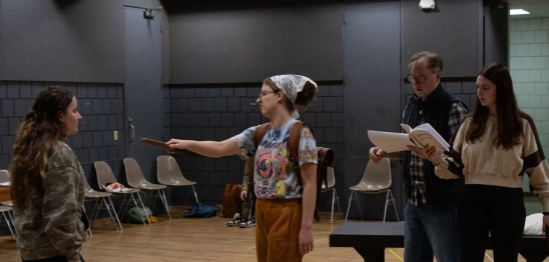
From left to right: CSB first-year Stella Neuenfeldt, CSB senior Megan Quinn, director and theater department chair Sean Dooley, CSB sophomore Brenna Kaufman.
CSB+SJU’s theater department will present “Dracula: A Feminist Revenge Fantasy, Really,” a reimagining of Bram Stoker’s classic horror novel adapted by playwright Kate Hamill. Rather than simply retelling the familiar vampire story, Hamill’s adaptation turns its attention towards the women who have traditionally occupied the sidelines, challenging expectations surrounding gender and power.
Originally published in 1897, Stoker’s “Dracula” follows Count Dracula and his attempts to establish himself in England, bringing him into conflict with a group of people determined to stop him. Hamill’s adaptation takes the familiar characters and gives the story a different perspective, exploring toxic masculinity and the ways women are expected to behave within a patriarchal society.
The production also turns some familiar character dynamics upside down. Several of the villains are women, challenging the traditional expectation that men occupy the roles of powerful monsters while women are left as helpless victims.
For CSB sophomore Eliana Szabo, the production’s stage manager, that reversal is one of the things that makes the play particularly meaningful.
“Traditionally, the roles of vampires and monsters have been played by men,” Szabo said. “It kind of goes against the stereotype that the men are the big bad ones and the women are the little helpless damsels.”
That shift is also reflected in the characters themselves. CSB sophomore Brenna Kaufman, who plays Mina Harker, described her character as a woman navigating the expectations placed on her by society. As the wife of Jonathan Harker, Mina initially occupies a more traditional role, but gradually discovers that she is capable of more than what others expect of her.
Stella Neuenfeldt, a CSB first-year who plays Lucy Westenra, also gets to explore the different sides of her character. Lucy is a young schoolgirl and friend of Mina whose personality changes throughout the production as she struggles between the person she presents to others and who she really is.
For Neuenfeldt, portraying Lucy has meant navigating several different versions of the same character, particularly as she becomes increasingly influenced by Dracula.
Andrew Higley, a first-year student at SJU, plays Jonathan Harker, and faces a similar challenge. Jonathan spends much of the production caught between his own consciousness and the influence of vampirism, requiring Higley to move between two very different versions of his character.
Higley said he hopes audiences leave the production feeling frightened, as the cast is leaning into the horror elements as much as possible for a stage production. At the same time, he said he hopes audiences recognize that this is not the Dracula story they might be expecting.
For the cast, the experience of bringing that story to the stage has also meant building connections with one another. Both Neuenfeldt and Kaufman described working with the cast as highlights of rehearsals, with Neuenfeldt particularly appreciating the opportunity to make friends during her first year of college.
That sense of community has a long history within the CSB+SJU theater program. According to their website, theater at the two institutions predates the establishment of a formal department, with student performance traditions dating back over a century. At St. John’s, the “Johnny Players” staged all-male productions, while St. Ben’s “Ardeleons” provided opportunities for women to get involved in theater. The separate organizations established the foundation for the shared theater department that exists today.
For the cast and crew of “Dracula,” the production is another opportunity to contribute to that history, whether on stage or behind the scenes. “Dracula: A Feminist Revenge Fantasy, Really” will run from Nov. 18-22 at the Gorecki Family Theater in the BAC. Tickets are available online at csbsju.edu/theater.